
Says Finance Ministry is working on tax structures as suggested by the Parliamentary committee

The code, which will replace the existing Income Tax Act 1961, aims to rationalise tax rates to bring more people and companies under the tax net.
.jpg)
The Direct Taxes Code bill was introduced in Lok Sabha in 2010 and Standing Committee on Finance has given a report after its scrutiny.

Union Finance Minister Pranab Mukherjee on Friday expressed firm commitment to enact the Direct Taxes Code (DTC) Bill at the earliest, after expeditious examination of the report of the Parliamentary Standing Committee.

The Direct Tax Code (DTC) Bill proposes to raise exemption limit for personal income tax from Rs 1.6 lakh to Rs 2 lakh, Finance Minister Pranab Mukherjee said.
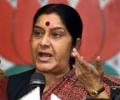
However, BJP has not given any assurance of support and conveyed to the Finance Minister that the matter will be discussed within the party and take a call, sources said.

The government has identified nine areas of concern in the Direct Taxes Code (DTC) draft, and they would be taken into consideration while it is being redrafted.

Expressing serious concerns over the DTC Bill, SEZ entrepreneurs on Tuesday said the proposed tax provisions would hit employment and drive away investors from the special economic zones.

Chidambaram wants it reworked; GAAR controversy weighs on implementation.

Implications for capital gains, wealth taxes, and investment strategies require careful consideration, notes Anil Rego, founder and CEO, RightHorizons.

As per the SEZ Act, 2005, and SEZ Rules, 2006, SEZ units are entitled to exemption from duty of customs and excise, exemption from service tax and VAT, exemption from stamp duty and registration fees and exemption from electricity duty, besides income tax exemption on export profits.

Finance Minister Pranab Mukherjee on Monday said the Direct Taxes Code (DTC), which will replace the Income Tax Act, is proposed to be implemented from April 1, 2012."

the government will introduce some of its key provisions, such as General Anti-Avoidance Rules, in Budget 2012-13.
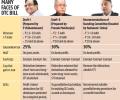
This means taxpayers might continue to enjoy exemption on maturity of their investments

Finance Minister Pranab Mukherjee on Thursday said the government would introduce the Direct Taxes Code (DTC) Bill that will simplify direct tax laws, in the monsoon session of Parliament beginning July 26.
Finance Minister P Chidambaram on Monday said he is reviewing the Direct Taxes Code (DTC) Bill and it will be introduced in Parliament after taking into account the recommendations of the Parliamentary panel.

'At least 25 Olympic-sized swimming pools worth of plastic chewing gum gets dumped.' 'And because the way people spit it out, there's no possible way this plastic can be recycled.'
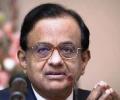
As chairman of the parliamentary standing committee on finance, former finance minister, Yashwant Sinha, says he is committed to expediting the legislative work associated with important Bills, including the direct taxes code (DTC) and Goods and Servies Tax.
At a press conference on Monday, Finance Minister P Chidambaram said when the final version of the Bill was tabled in Parliament, the government would abide by the recommendations of the parliamentary standing committee on DTC.

Salaried taxpayers may have less kitty for holidays from April 2012, with the government proposing to scrap tax incentives on leave travel allowance in the new direct tax regime DTC.

It's important to make the penalty system an effective deterrent to ensure greater efficiency in the tax system, says M Govinda Rao.
Financial and tax expert Anil Rego of Right Horizons has his doubts.

A panel will draft direct tax legislation, keeping in mind the system in other countries, international best practices and economic needs of the country
.jpg)
Cabinet likely to pave way for the 'super-rich' tax today.

The panel of Parliament examining the Direct Taxes Code (DTC) Bill has almost finalised its recommendations. It wants more taxpayer-friendly measures.

The government will lose over Rs 53,000 crore (Rs 530 billion) in tax revenue on account of the increase in exemption limits and tweaking of slabs in the Direct Taxes Code Bill, which will come into effect from April 1, 2012, a year behind the previous deadline.

The Committee, in an earlier report on the Direct Taxes Code (DTC) Bill, had favoured abolition of STT.
Taxpayers are not likely to get as much relief as was proposed in the discussion paper on the Direct Taxes Code last year, with the Finance Ministry saying that the tax slabs may be narrowed down in the bill, slated to be tabled in the monsoon session of Parliament.
A Parliamentary committee scrutinising the Direct Taxes Code (DTC) Bill will recommend raising of the annual income tax exemption limit to Rs 3 lakh.

An assessee's interest in a foreign trust or a company is also proposed to be made taxable assets under the new tax regime.
While the tax burden for an average taxpayer will lighten marginally, for tax evaders the Direct Taxes Code proposes to reduce penalties substantially.
Tax payers will be looking forward to some relief from Finance Minister Pranab Mukherjee who is expected to raise the income tax exemption limit to at least Rs 2 lakh in his budget proposals.
He has spoken to the party's heads in the Lok Sabha and the Rajya Sabha, Sushma Swaraj and Arun Jaitley, respectively , to seek support for the two items of proposed legislation. He got no assurance.

Years of wait before DTC, GST are rolled out

The I-T officer can go back up to six years to scrutinise the books of accounts of the assessees.
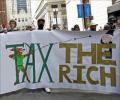
The proposal to levy a 'super-rich' tax, at the rate of 35 per cent, on those earning more than Rs 10 crore a year might not receive support of the Union Cabinet.

But contentious areas like special economic zones, capital gains and Ulips may see changes
Arun Jaitley said he would put the DTC Bill in cold storage.
The annual Finance Bill may soon become far less exciting as the government plans to lift the veil of secrecy surrounding tax proposals in Budget. Once the Direct Taxes Code (DTC) and Goods and Services Tax (GST) are in place, the finance ministry will adopt a public discussion approach for most future decisions, while confining the annual exercise to a few procedural changes.
 © 2026 Rediff.com - Advertise with us - Disclaimer - Privacy Policy - Sitemap - Feedback - About us - Terms of use - Grievances